
What Harris County Deed Records Say about a Transfer
The Harris County Clerk of Superior Court records each instrument and the parties and property description written into it. Every deed type tells you something different. A warranty deed, security deed, and quitclaim each carry distinct language and serve distinct functions, so the label shapes what the document actually proves about a transfer.
| Deed Type | What It Does | Common Use |
|---|---|---|
| Warranty deed | Conveys the stated interest with warranty language. | Ordinary sales. |
| Quitclaim deed | Conveys whatever interest the grantor may hold. | Interest cleanup or known-party transfers. |
| Security deed | Places a lender's secured interest of record. | Financing, not a new owner transfer. |
| Assignment or cancellation | Moves or releases a secured interest. | Following a loan and its release. |
| Easement or right-of-way deed | Records access or a limited interest. | Explaining use rights. |
Not every indexed item is a conveyance. A security-deed cancellation releases a lien without moving land, and a lien records a claim while title stays put. Trust each record's own category rather than calling everything a deed.
Walking the Harris County Grantor-Grantee Index
The Clerk's FAQ draws the line clearly: the grantor transfers, the grantee receives. Search the index in both directions, because one person often shows up on several sides of different deals. Match each result to the parcel's complete legal description before trusting it.
- Use qPublic to get the displayed owner, parcel ID, acreage, and map location.
- Search the owner as grantee and identify the acquisition deed.
- Read the grantor and full legal description from the image.
- Search that grantor as grantee to find the prior acquisition and repeat.
- Check security deeds, releases, liens, easements, and plats for each party.
- Grantor
- The party transferring the stated interest.
- Grantee
- The party receiving that interest.
- Chain of title
- The ordered trail of conveyances for one tract.
- Book and page
- A durable reference used to retrieve and join an instrument.
Kofile Fields That Narrow Harris County Deed Records
Kofile Quicklinks offers a historical search route plus direct entry by known reference. Preserve every clue you find. Guessing from a surname alone leads nowhere.
| Field | Input | Use |
|---|---|---|
| Type | Record category | Limits the material searched. |
| Year | Year choice | Narrows a broad query. |
| Parties | Party role | Supports grantor and grantee work. |
| Last and First Name | Party text | Finds people with order and spelling checks. |
| Book, Volume, Page | Known reference | Retrieves a specific index location. |
The platform's exact year filters, party options, sort orders, and download rules vary, so plan to explore them in place. Search any bank, firm, or church under its full organization name.
Online Coverage and Courthouse Books in Harris County
Online coverage is broad but layered. The Clerk reports real-estate documents from 1976 forward, liens from 2001, and plats from 1945. Quicklinks adds a Harris plat index covering 1905 through 1999. It also includes deed and mortgage indexes. An index and an image are different layers. Confirm the actual book and page every time. Earlier volumes rest in the Clerk's office back to 1828. When an image is missing online, use the public terminal or ask staff to view and copy the book. Georgia Archives microfilm and FamilySearch fill historical gaps. The courthouse copy remains the recorded source of authority.
Note: An online cutoff only points you to another access channel, not to the end of Harris County deed records.
Harris County Deeds Are Only Part of the Recorded Trail
Deed records are just one strand of the trail. Pull security deeds plus later assignments and cancellations. Hunt for easements, rights-of-way, powers of attorney, plats, fi. fas., tax liens, mechanic's liens, and judgments, since the newest warranty deed can miss a claim or access right that explains the whole parcel.
Check land lot, district, lot number, metes-and-bounds calls, and plat references against the full legal description. GIS is orientation, not proof. Where facts hint at litigation, Harris Superior Court handles quiet title, partition, foreclosure, lis pendens, and other land cases.
Local and Statewide Routes to Harris County Records
The Clerk links Kofile for local real-estate searching and images. Quicklinks covers historic indexes and known references. GSCCCA adds statewide name, book/page, property, instrument, plat, lien, UCC, and PT-61 searches. Some tools need an account or payment. Treat these systems as cross-checks. Then read the image itself. Convenience charges are not posted at a flat rate. Expect them to vary by service. Record the service, date, party role, document type, and reference. Anyone can repeat the search later.
FANS Alerts Do Not Prove a Harris County Deed Claim
The FANS property-fraud notification service sends alerts when the Clerk transmits matching index data. It works best as a forward-looking signal once names tied to a parcel are known. FANS itself cautions that alerts may not be comprehensive or current. Open the actual image. Call the Clerk when in doubt. An alert alone proves neither fraud nor title.
Recording Fees and the 2025 eFiling Change
Recording rules changed with the new year. Beginning January 1, 2025, the Clerk requires self-filers to eFile real-estate documents. Office terminals are available, but clerks cannot help with the filing itself. Any submitted instrument must already be witnessed and notarized.
Filing fees are set: $25 for a real-estate document, $10 for a plat, $25 for a lien. Each cancellation or assignment also costs $25. Make checks payable to Harris County Clerk of Court and mail them to P.O. Box 528, Hamilton, GA 31811. Recording a new instrument is separate from ordering a copy.
See the Harris County Clerk's Recorded-Land Gateway
The Clerk's real-estate page opens the official path to Harris County deed records, plats, liens, UCC filings, and linked search services.
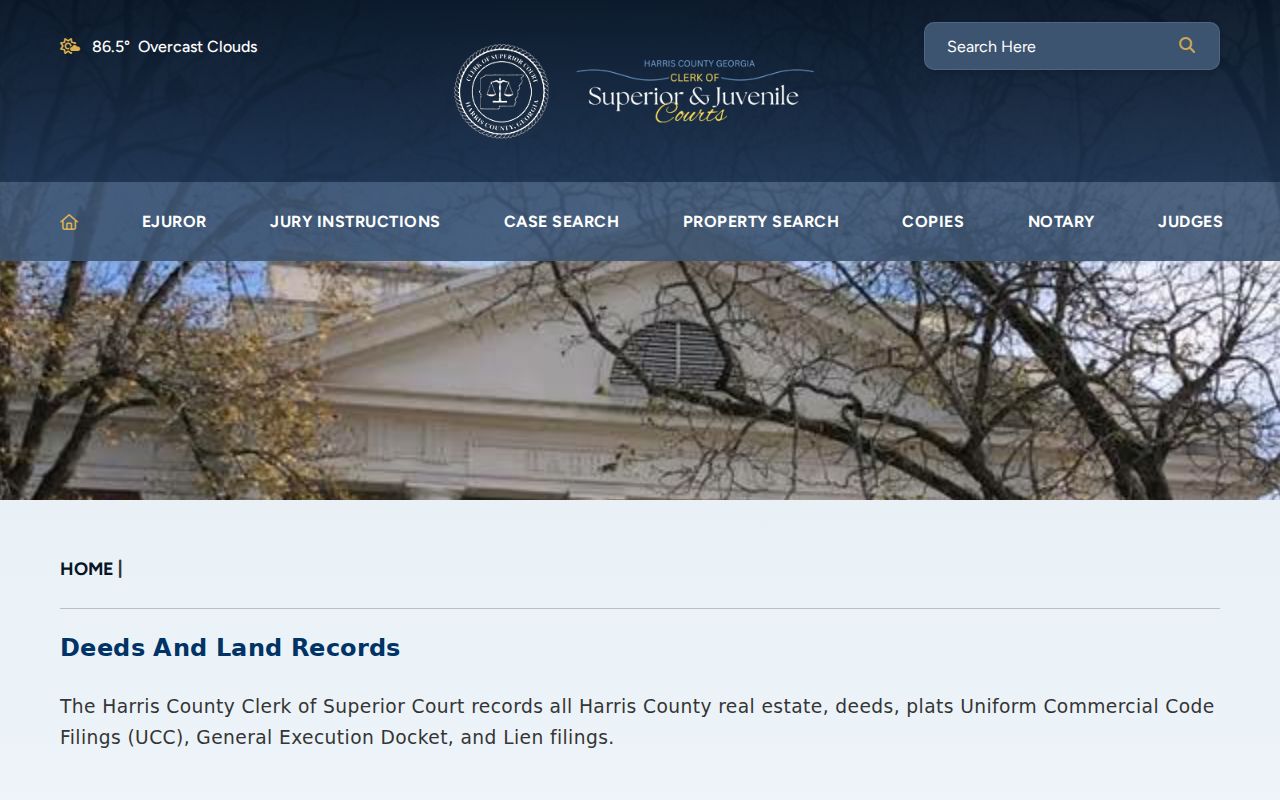
The page confirms that recorded-land research starts with the Clerk. From there, a searcher can move on to Kofile or the statewide GSCCCA tools. It also keeps the office source tied to any portal result.
When Harris County Deed Names Do Not Match Cleanly
Names rarely line up neatly. An individual may be indexed in a different order or with a variant spelling. So try reasonable forms in both party roles. For a bank, company, or church, search the full organization name rather than a single officer. Then compare the legal description, record type, and date before accepting a match.
A mailing address or land-lot shorthand can narrow results. But neither establishes identity on its own. Book and page are stronger join keys once you have them. If a power of attorney, estate, or business entity explains a signer, follow that related record instead of assuming the signer personally took the land.
How Harris County Deed References Join Separate Records
Book and page references do quiet work that an address cannot. A street number can change. A mailing address can mislead. Common names multiply across the index. The recorded reference cuts through all of that. Once you have it, carry the number from the index line into the deed image itself, and note any plat book, prior deed, easement, or security-deed reference the instrument cites. Every cited item becomes a small, bounded follow-up search instead of a geographic guess.
Dates deserve equal discipline. Execution, signature, recording, assessment upload, and tax-account update can each fall on different days. For a recent conveyance, write down the instrument's execution and recording details, then check the qPublic timestamp against them. That one comparison often explains why the assessment screen still shows a prior party, and it does so without accusing the tax roll of error.
Legal descriptions need exact handling. If the instrument names a land lot, district, subdivision lot, or recorded plat, keep that wording verbatim. The short index description exists only to speed retrieval. It is not a substitute for the full description. When two instruments seem to touch the same tract, compare acreage, calls, plat links, and predecessor references before joining them.
Releases reward the same care. A cancellation tied to a security deed should trace back through the original reference. It proves the secured instrument was released, not that ownership shifted. An assignment works the same way: the lender's interest moves, while the titled owner stays put. Category, party role, reference, and date, read together, keep Harris County deed records from saying more than they should.
Preparing for a Harris County Clerk Search in Person
Check the Clerk's site before you drive over. Check the county site too for current operating notices. Bring names in several likely spellings. Bring the parcel ID, physical and mailing addresses, a date range, known document types, and every book and page you already hold. For older volumes, say plainly that the online image was unavailable. Name the volume you need.
At the public terminal, log your exact query and its result. Ask staff about viewing and copying options rather than requesting a title abstract. A mailed request works best with a precise instrument reference, not a broad property-history question. Some online providers demand an account or a fee. That makes the counter a durable alternative. Every channel serves one aim: retrieve the recorded item and read what it actually says.
Ways to Obtain a Harris County Deed Copy
The Clerk's office sits at 102 N College Street in Hamilton. A self-service terminal copy runs $0.50. A copy made by the Clerk runs $1.00. Online copies through eCert or Kofile require an account and payment, and the convenience charge varies. Any certified-copy surcharge varies too. So confirm the current total. A mailed request should identify the parties, instrument type, date, and book and page.
Public terminals remain the fallback for old books and portal trouble. Georgia Open Records requests can reach administrative materials. But deed copy access follows the Clerk's recording process. Archives serve historical discovery, not an authoritative replacement copy.
Recorded, not guaranteed. Harris County deed records show what reached the recording system. They are not a title opinion, and unrecorded interests or indexing errors may exist.