
Trace Harris County Former Owners
Ownership runs backward. You start from the newest verified deed, never from an old surname. The Harris County Clerk keeps grantor and grantee indexes. A grantor conveys an interest. A grantee takes it in, and each step must match the full legal description, land lot, district, subdivision, acreage, and plat before a name alone means anything.
| Source | Years It Covers | Where Held | What It Shows |
|---|---|---|---|
| Recorded real-estate documents | 1976 to present online | Kofile, GSCCCA, Clerk | Deeds, parties, book/page, images |
| Courthouse deed books | Back to 1828 | Clerk's office | Earlier deeds and former owners |
| Recorded plats | 1945 to present online | Clerk systems | Subdivision and lot context |
| Quicklinks plat index | 1905 through 1999 | Kofile Quicklinks | Historic plat citations and leads |
Online indexes cover the modern chain. Older transfers need the courthouse. Historical index coverage and online images are different things, so note whether each result is an index entry or the recorded image itself.
Build a Harris Deed Timeline
A timeline tames the chain. Build a dated table that opens with the deed vesting the current grantee. That deed's grantor is your next former owner. Search that person or entity as a grantee in the earlier record, and never invent a transfer the index fails to show.
| Transfer date | Grantor to grantee | Deed type | Book/page |
|---|---|---|---|
| Newest verified recording | Prior owner to current grantee | Copy the instrument label | Record the Clerk citation |
| Prior verified recording | Earlier owner to prior grantee | Keep warranty and quitclaim distinct | Use the deed's cited reference |
| Older book entry | Repeat the backward link | Preserve the historic label | Note book, page, and access source |
Note: Tag every row with a confidence level, such as index only, image reviewed, or courthouse copy, so gaps stand out.
Walk Harris Deeds Backward
Party search works from a bare name. Book, volume, and page work from a known deed. The Kofile Quicklinks index supplies Type, Year, Parties, Last Name, First Name, Book, Volume, and Page controls for either route.
- Find the present owner's purchase deed with that owner or entity as grantee.
- Read the grantor, legal description, deed type, recording date, and cited prior instrument.
- Search that grantor as a grantee to locate the deed by which the former owner received the land.
- Repeat until online coverage ends, then continue in the courthouse books or archival finding aids.
- Grantor and grantee
- The conveying and receiving parties named by the instrument.
- Chain of title
- The ordered sequence of recorded transfers for the same land.
- Reverse index
- An index organized by the receiving party, useful for finding an owner's purchase.
- Legal description
- The land description used to confirm that each deed concerns the same tract.
- Quitclaim deed
- An instrument conveying whatever interest the grantor has, unlike a warranty deed's stated covenants.
Match Harris Legal Descriptions
Street addresses shift, and old deeds often skip them. The land itself is the anchor. Follow the legal description instead of the address. The Clerk's FAQ points to land lot, district, and the complete description, and subdivision name, lot, block, acreage, adjoining owners, metes-and-bounds calls, and plat references can tell two same-named people apart.
Book and page work as the join key. Keep the current deed, the prior deed, and plat citations together in one crosswalk. Add the parcel ID for current assessment work. Just do not expect it inside every old instrument.
Security deeds, assignments, cancellations, easements, liens, and powers of attorney sit beside ownership deeds in the index. Keep each category labeled, since a cancellation after mortgage payoff releases a security interest rather than transferring ownership to anyone new.
Climb Harris County's Old-Record Ladder
Every ladder ends somewhere. Courthouse books reach back to 1828. When the chain outgrows online deeds, climb from those books to the Quicklinks plat index, Georgia Archives county cards and microfilm, FamilySearch's Georgia wills and deeds, and local historical collections. Each source has its own coverage and access limits.
The Georgia Historic Newspapers Harris collection spans 1854 through 2015. A notice is not a deed. It can still flag an estate sale, foreclosure, road matter, or former owner. Probate shows who had authority to convey estate land, and the later recorded instrument proves the transfer itself.
Label every piece of evidence. Whether it came from an index, an image, a newspaper, a probate file, or the recorded instrument, the label keeps a historical clue from hardening into an ownership claim.
Search Harris Former-Owner Variants
Names come in many costumes. Try surname-first and given-name-first forms, initials, middle names, married names, corporate suffixes, churches, banks, and business titles. When the direction is unclear, search the former owner in both party roles. Then match description and book and page.
One entity can wear many hats. It may appear as grantee, grantor, lender, assignee, lien claimant, or estate representative, so a repeated name says nothing until the address, parcel, deed description, or business control number agrees.
State the gap. “Not found in the inspected index” is accurate only when the roles, variants, date range, and published coverage are recorded.
Reach Harris Historical Deeds
Online routes include Kofile, Quicklinks, and the GSCCCA search. The Clerk also runs public terminals at 102 N College Street in Hamilton. Mail requests go to P.O. Box 528, Hamilton, Georgia 31811. Copies cost $0.50 at the self-service terminal and $1.00 when the Clerk makes them. Online copies need an account and payment.
Phone and office details sit on the Clerk site. For older context, Georgia Archives, FamilySearch, the Troup-Harris Regional Library, and newspapers can stretch the trail further back. None of them replaces a certified Clerk copy.
Check county notices before a courthouse trip. A February 27, 2026 closure announcement shows access can pause, so a fallback plan keeps former-owner work moving without mistaking the web for the full record.
Review Harris Deed Index Access
The Clerk-linked Kofile Quicklinks index remains the official route for searching Harris County's historical deed books by book and page.
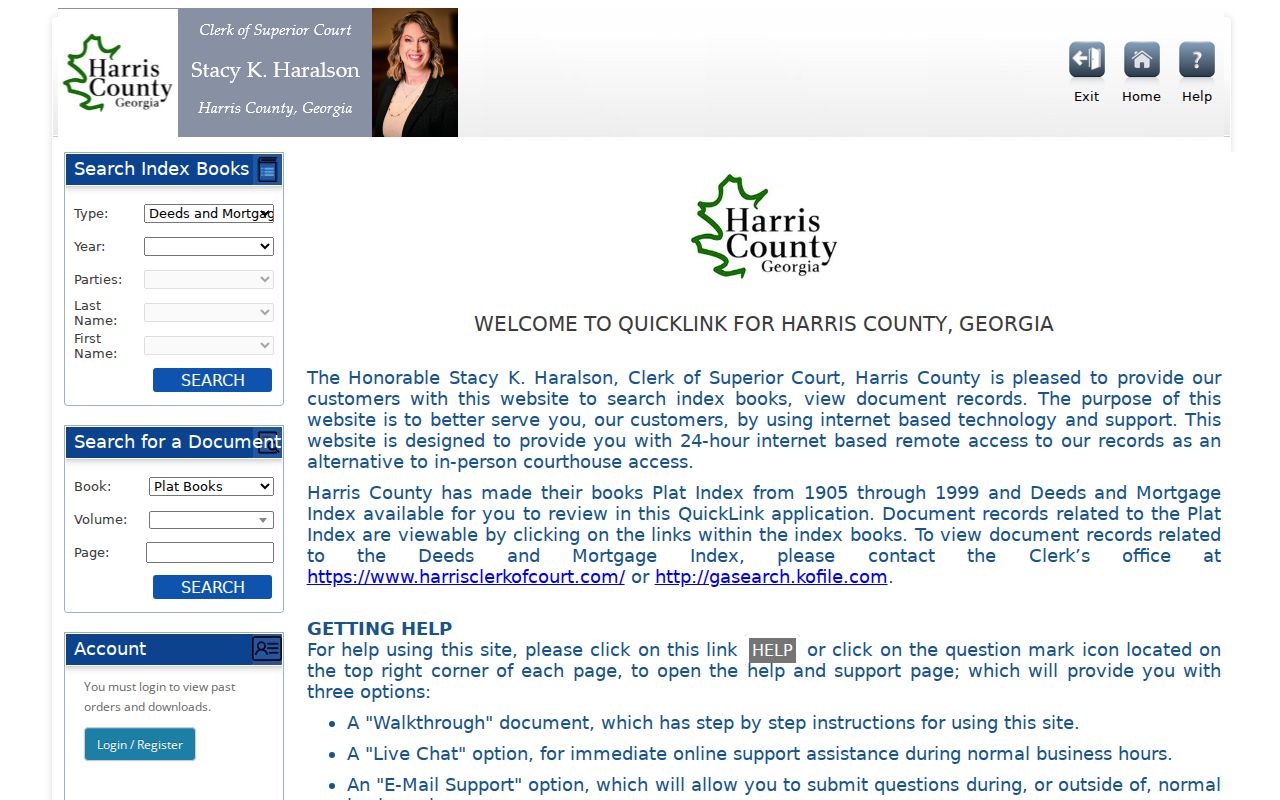
The official index anchors the backward deed workflow. Pair every book and page with the Clerk's grantor-grantee guidance and the complete legal description before trusting a link.
Connect Harris Estates to Deeds
A death can break a tidy chain of buyers and sellers. An obituary may name relatives. A restricted vital record may certify an eligible fact. And Probate may grant estate authority. Still, none of those alone shows that the land reached a former owner.
Treat them as leads. The real proof is a deed, administrator's deed, or another recorded instrument. That instrument conveys the tract. Match the legal description exactly. Keep the probate case reference too, since it can explain who signed and why.
Follow Harris Places Through Records
Treat project and subdivision names as index terms, not as legal boundaries. Woodland Hills and Maffey Road show up in a development notice. McKee Road appears in Planning Commission material. West Point plans name Laroza Heights, Hugh McCulloh subdivision, and Winston Estates. Run each name through plats, deeds, planning files, and later permits.
Status matters as much as the name. A planning agenda proves only that a matter was considered. It does not prove the plat was recorded or the work was built. The deed and plat citations tie a place name to the former owners of one parcel in Harris County.
Depth of Harris Ownership Records
Harris County courthouse deed books go back to 1828. That is the year the county itself was created. Online access is newer. Recorded real-estate documents run from 1976, plats from 1945, and liens from 2001. Tracing earlier owners therefore takes a mixed workflow rather than a single portal.
A chain ends only where the searching actually stops. Write down the last date searched and the name variants. Note the party roles, years covered, and book and page references. Record any gaps left unresolved, too. If no deed surfaced, do not claim the transfer never existed. Older assessment rolls, probate files, archives, and newspapers can suggest the next search. Only the matching recorded transfer belongs in the deed chain, though. Keep that line firm.
Lawful use. Harris County former-owner research supports house history, estate work, and property diligence. Never use it to track, stalk, harass, or harm a living person.